124+ Organic Leads and a 6-12x ROI: 6-Month Legal SEO Results for a Toronto Paralegal Practice
Six-month legal SEO case study for a Toronto paralegal practice. 124+ total organic leads across email, phone, and GBP. 6-12x ROI on base fees. Zero backlink spend. Full strategy and thought process.
Educational, helpful, updated, and exhaustive content (ex. resources, guides, processes); appropriate site and linking architecture (ex. services, resources, intention clarity); a strong technical foundation (ex. exhaustive and accurate schemas, metadata, performance, semantic accuracy, browser access and hydration); intelligent internal linking (ex. contextual anchor text with appropriate content padding, genuine congruity and association between parts, optimized ratio of linking to content); consistency (periodic, predictable, meaningful content and updates) - these are some of the foundational elements of successful search visibility in 2026, as they were twenty years ago, and as they will be in an AI search future. Whether your users and clients find you through Google, Bing, AI search, or LLMs, the formula is the same. Build the right pillars and do so well, continuously enhance and maintain them, and you will have a baseline of success. Do these things diligently, accurately, consistently, and with intention, and you will excel - as will your business.
It is now six months into my growth partnership with Azimi Legal Services, a licensed paralegal practice based in Toronto. This engagement started with no organic browser visibility, a corrupted WordPress site, and a primarily referral-based practice built on honesty, integrity, and genuine experience accumulated over years in one of the most competitive legal markets in Canada, if not the world. The results below represent what six months of structured, intentional legal SEO practice produces when the foundation is built correctly and the strategy is followed through. Even with this significant progress, it is still only the beginning of what this campaign will achieve in the coming months and years.
Every result above was achieved without spending one dollar on backlinks, paid citations, or any form of link acquisition. No outreach, no directories paid for, no shortcuts. Pure content strategy, technical architecture, and consistent execution. The most important measure in any SEO engagement is not impressions, average position, or CTR - it is the bottom line. Leads in, cases booked, revenue generated. By that measure, as well as by traffic metrics, this engagement is performing strongly, and the trajectory is still compounding upward.
| Metric | Sep 2025 (Baseline) | Dec 2025 (Month 3) | Mar 2026 (Month 6) |
|---|---|---|---|
| Organic Impressions | 0 | 14,500 | 195,551 |
| Organic Clicks | 0 | 184 | 1,187 |
| Keywords Ranking | 0 | 197 | 3,094 |
| Positions 1-3 | 0 | 10 | 1,247 |
| Top 10 Rankings | 0 | 26 | 1,719 |
| Email Leads (cumulative) | 0 | 17 | 47 |
| Website Call Interactions | 0 | 8 | 54 |
| GBP Direct Calls | 0 | - | 23 |
| Pages Generating Impressions | 0 | ~6 | 55 |
Atlas Arrow Digital
The technical foundation rebuild and the decisions behind it are documented in the Azimi Legal Services site foundation article. The first three months of results - 0 to 197 keywords ranking, 10 position-one rankings, and 25 lead actions in the first 90 days - are covered in full in the 3-month legal SEO case study. This article picks up from Month 3 and covers the second half of the engagement: the strategy behind each decision, the cluster-level performance data, the compounding gains, and the lead outcomes.
Strategy and Thought Process
A successful legal SEO engagement requires a sequenced strategy that continuously adapts to the related marketplace. The order of operations matters as much as the work itself. My approach with this client followed a clear sequence: fix the technical foundation first, build commercial and transactional service pages second, then deploy an informational content pipeline calibrated to build topical authority while simultaneously functioning as a passive lead funnel, then continue to enhance and update all content pages.
Each phase of search visibility campaigns for professional businesses enables the next. Content published on a broken technical foundation is like pouring water onto cracked cement. Commercial pages should be built with optimization intent right away, but realistically - surrounding authority from tangential content is almost essential to enhance the credibility and ranking of the revenue-generating pages. Those informational pages also act as terrific lead generators in themselves. For professional businesses like legal practices and law firms, the web of successful informational pages and internal linking gives those pages authority over time, and the overall brand strengthens and gains more trust across search surfaces - browsers and LLMs alike.
Each practice area - LTB, Small Claims, Notary, Business Services - is like a knob that can be turned up, down, or kept in place. Turning one up means increasing content production, internal linking density, and optimization focus in that cluster. The principle is straightforward: you do not turn all of them to maximum at once. Flooding the site with content across every category simultaneously burns through your best material early, creates thin coverage across too many fronts, leaves you with lower-quality reserves precisely when competition starts responding to your early gains, and the algorithm wants to see your consistency and expertise over time (and will punish you if you try to game the system too quickly and especially too clearly automated). Instead, I established the cluster foundations first, watched which ones produced lead activity, then turned attention and effort up on specific clusters deliberately and in sequence based on real data and realistic industry revenue potential by legal practice area relevant to my client.
Step by Step
First step after creating the website with a strong technical foundation was creating all of the commercial pages and topical architecture, and then onto the informational resources to establish my client's site as a practical resource and process directory for their primary practice areas.
The first informational category I started improving was Notary. It was the client's most active lead category at the start of the engagement and the lowest-competition cluster to establish rankings in quickly. There weren't any strong leading resources for the forms and processes already established in Ontario search results either. My client's site was ranking first for several notary-related legal forms in Ontario, surpassing official government form resource sites. Early notary traffic and rankings produced early lead data and traffic to help boost authority and expertise indicators. Indeed, visitors that came by way of organic notary resource results spend over 1 minute of active engagement on average, with LTB form guides ranging from 46 seconds to over 2 minutes - users working through real documents for active legal situations.
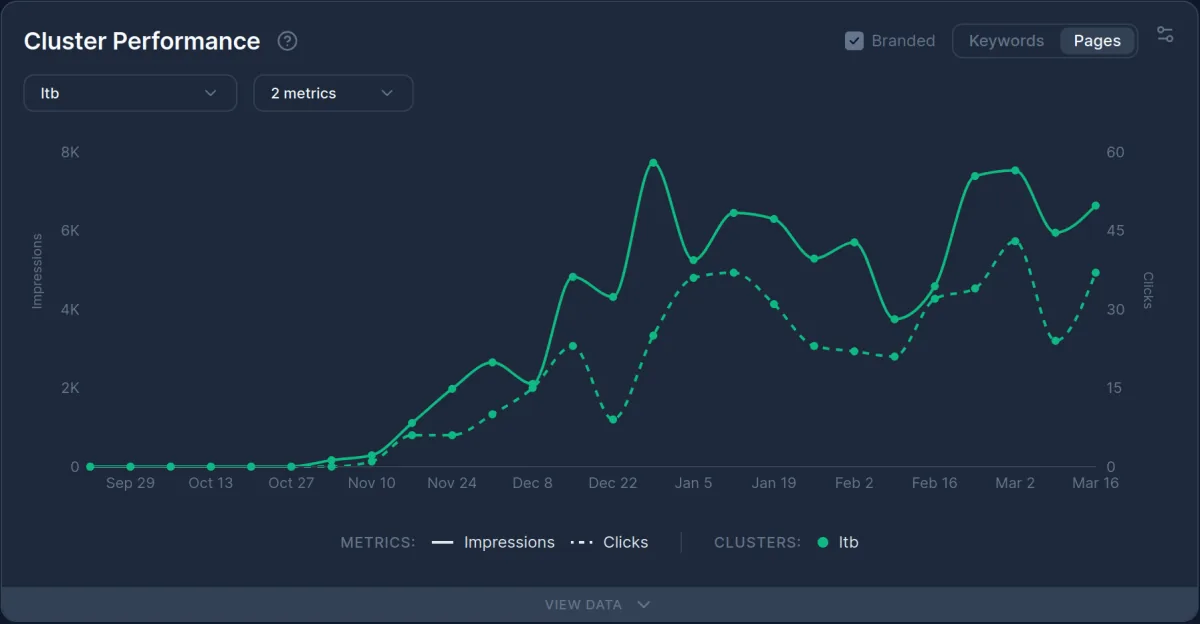
Once traffic and authority were building through notary content, competitor practices began improving their efforts for the same notary-related forms and processes. My client was ranking above government sites for many of the official LTB and court forms - the very sites that host the source documents. The site recorded 389 downloads of Ontario legal forms across this period, a direct signal of engaged, high-intent visitors. It was at this point I decided the low-hanging fruit of that category was realized and maintaining the cluster performance was adequate for now. My next step for my legal services client's digital growth campaign was to focus on accelerating the LTB and Small Claims clusters - these became the priority past month 3. Azimi Legal Services has significant experience and expertise in LTB matters with a strong record of results. Landlord and Tenant Board representation is both the practice's highest-revenue category and one of the most actively contested areas of Ontario law, with persistent backlogs, ongoing regulatory change, and a landlord-tenant market in the GTA that keeps demand consistently high. I accelerated content production and topical authority building for the LTB cluster and the results were significant. You can see the cluster performance across the engagement on the Keypulse dashboard below. LTB leads increased substantially over the final six weeks of the engagement - 16 email leads across February and March alone, with March producing 11, the strongest single month of the entire engagement, including five LTB leads in a single week. There is strong crossover between LTB and Small Claims matters in this practice, and these are the highest revenue-earning case types with strong base fees and meaningful disbursements on top.
Month by Month
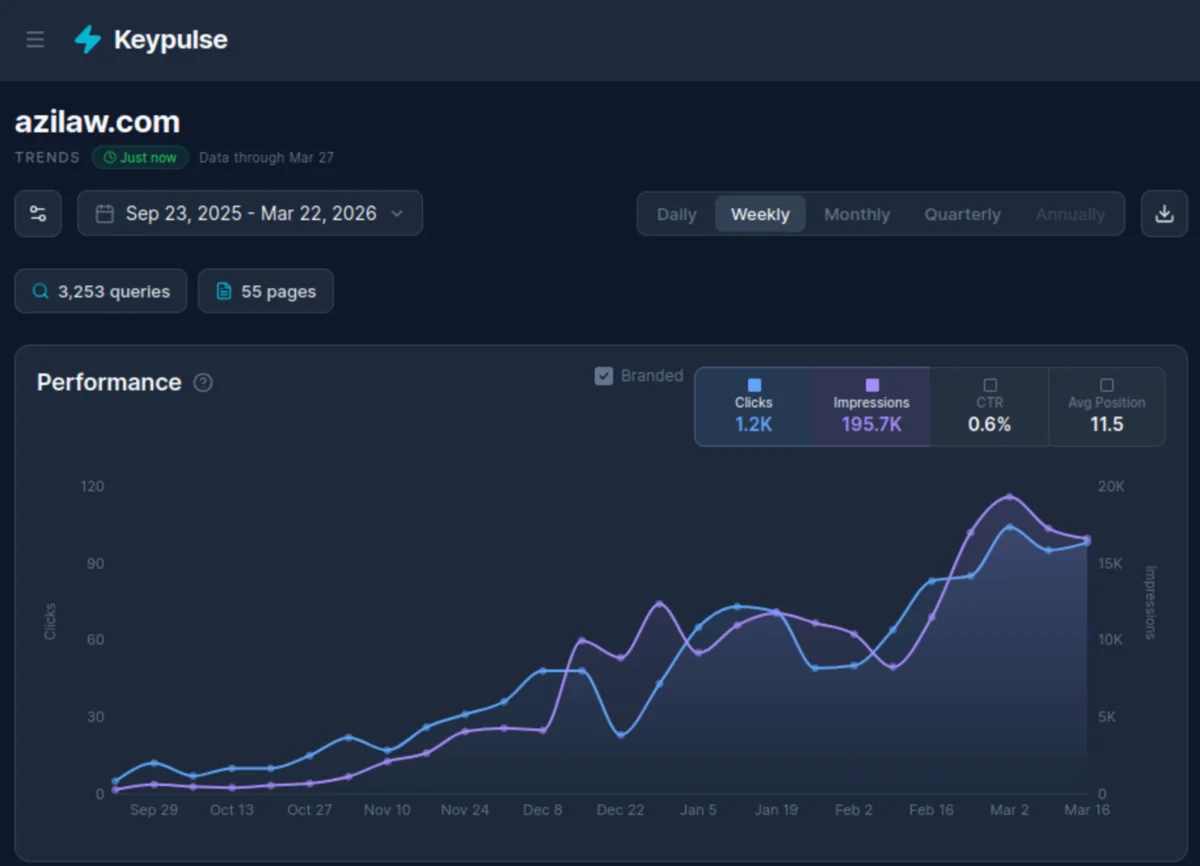
Legal SEO compounds in phases, and each phase creates the conditions for the next to accelerate. At the end of Month 1 the site had 562 impressions and 14 clicks. By Month 2 that was 2,580 impressions and 70 clicks. By the end of Month 3 it was 14,500 impressions and 184 clicks. Each month's content investment was building the topical foundation that made the next month's ranking gains possible. The strategy and the sequencing are what separate compound growth from a flat line.
Months 1 and 2 were entirely foundational. The WordPress site had a fatal admin error, no robots.txt, zero schema markup, and a technical health score of 45 out of 100. A complete rebuild was the only viable path. The new site launched on September 26th with proper technical infrastructure, 13 schema types, LiteSpeed cache configuration, and a semantic URL structure that would support the content architecture to come. The first legal form guides went live alongside the core service pages. The full technical rebuild process and the decisions behind it are documented in the site foundation article and the technical SEO overview for this engagement.
Source: Keypulse | Click to enlarge
The December 15th week was the first significant inflection point, with total weekly impressions crossing 5,000 for the first time. This reflected the LTB and Notary content clusters reaching critical mass simultaneously after weeks of steady content publication across both clusters through November and early December. The foundational content published in September and October had been indexed, processed, and trusted enough by Google to begin ranking meaningfully - producing the December surge that validated the sequencing approach. The weekly performance chart above shows this curve directly - the impression line rising steeply from near zero in September to over 5,000 weekly impressions by mid-December, then stabilising and climbing again through March.
From January through March, the focus shifted to turning up the LTB knob aggressively. More N-series form guides, deeper process content, stronger internal linking from the informational layer into the LTB service pages. The cluster response was direct and measurable. LTB average position improved from the high 20s in November to approximately 8.9 by the week of March 16th. By March, the client was receiving 10+ LTB email leads per month including 5 LTB email leads in the most recent week before publication - the clearest possible proof that turning a cluster knob up produces a proportional lead response when the foundation underneath it is solid and at the right time for the market demand.
Source: Keypulse | Click to enlarge
Cluster Performance
Building authority and expertise across search surfaces for a professional service business like a legal practice means establishing the brand as a credible, well-connected entity across a defined set of practice areas - not just ranking individual pages in isolation. Each page on the site contributes to the collective expertise and authority signals that search engines and AI systems use to understand what a practice genuinely specialises in. Pages reinforce each other through internal linking, shared topical signals, and the cumulative entity footprint they create. The Keypulse cluster data below shows how that authority has distributed across the six practice areas built over this engagement.
| Cluster | Queries | Impressions | Clicks | CTR | Avg Position |
|---|---|---|---|---|---|
| LTB | 677 | 27,929 | 72 | 0.26% | 19.9 |
| Commercial / Hiring Intent | 272 | 9,314 | 88 | 0.94% | 33.0 |
| Notary & Commissioner | 902 | 7,434 | 13 | 0.17% | 30.8 |
| Small Claims | 473 | 6,900 | 15 | 0.22% | 30.0 |
| Uncategorized | 697 | 4,663 | 34 | 0.73% | 11.9 |
| Business Services | 29 | 708 | 0 | 0.00% | 25.1 |
Atlas Arrow Digital
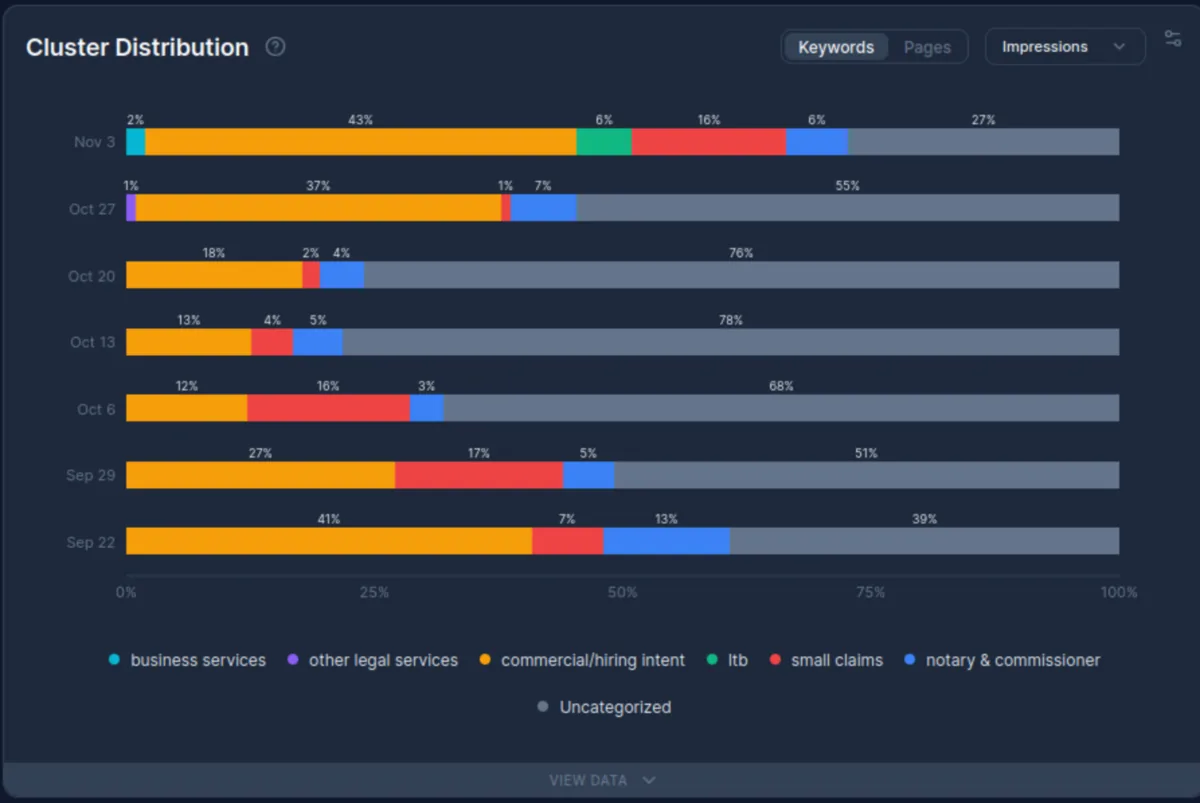
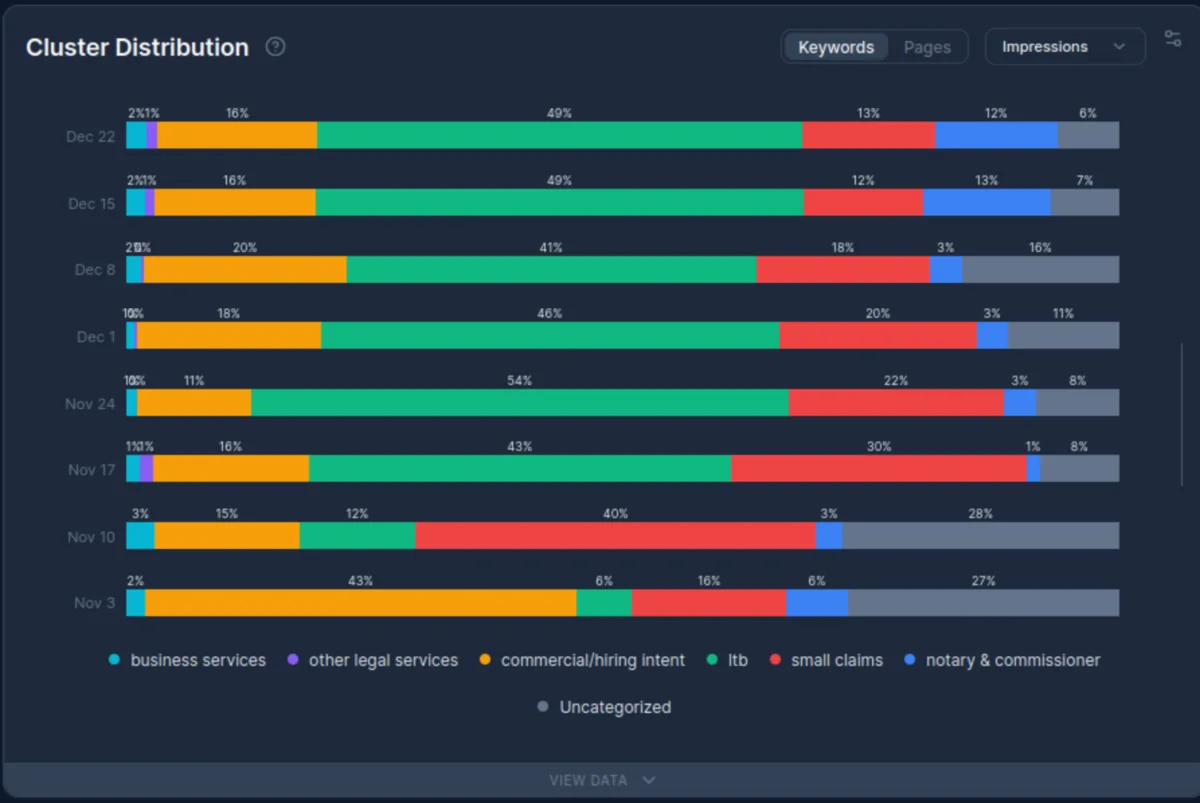
The three charts below show how impressions distributed across practice area clusters across the three phases of the engagement - September through early November as the site was being established, November through late December as the LTB cluster ignited, and January through March as LTB consolidated and Small Claims began its breakout. On desktop these display side by side for direct comparison.
Source: Keypulse | Click to enlarge
Source: Keypulse | Click to enlarge
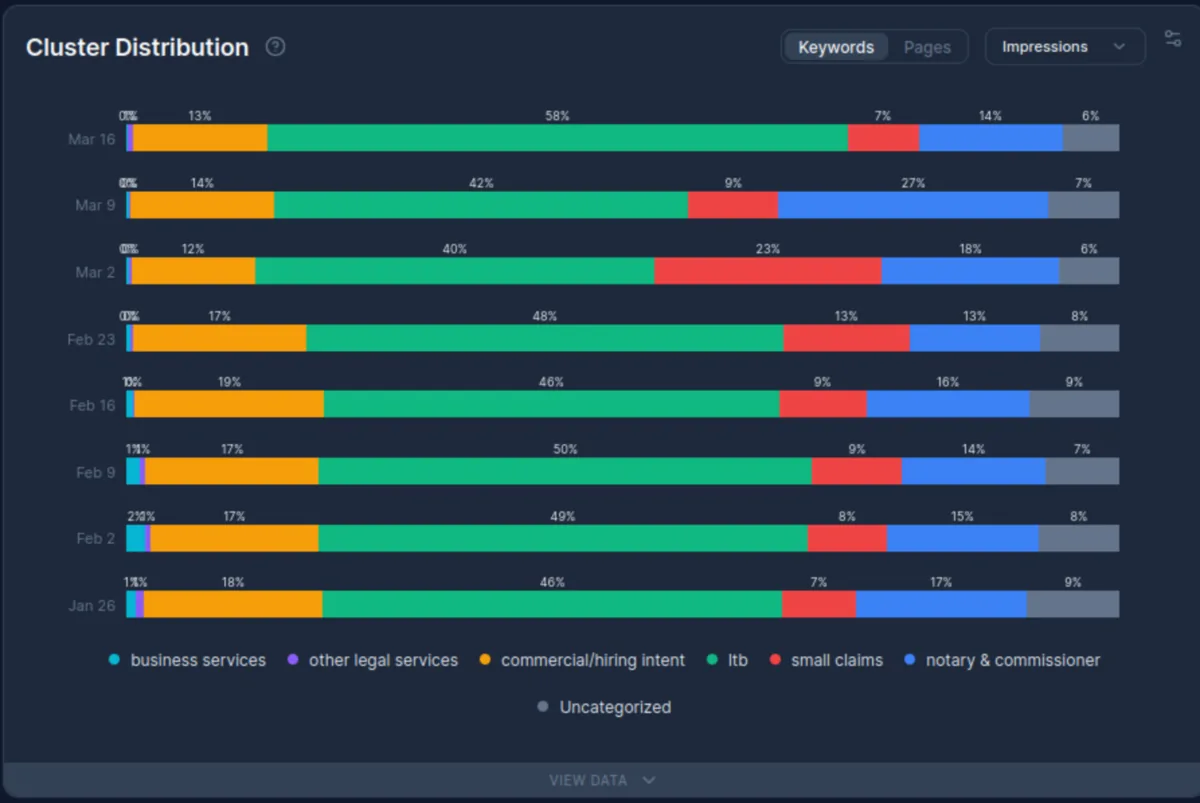
Source: Keypulse | Click to enlarge
The Commercial and Hiring Intent cluster holds the highest CTR of any cluster at 0.94%, sitting at average positions between 10 and 25. Searches like 'LTB paralegal Etobicoke,' 'landlord tenant board paralegal Toronto,' and 'landlord representation LTB hearing' are hiring-intent queries - these searchers have already decided they need professional help and are comparing options. That 0.94% CTR from mid-page positions signals what the conversion rate will look like when those pages reach the top five. The LTB informational cluster generating 27,929 impressions feeds authority into these commercial pages directly through internal linking and topical coherence.
The Small Claims cluster was February's standout performer, with weekly impressions tripling from 228 to 683 as new content pages matured in Google's index. The Notary cluster holds the most unique queries of any cluster at 902, generating impressions at an average position of 30.8 - these are pages that are indexed, accumulating authority, and moving upward. The same trajectory that took LTB from the mid-20s in November to 8.9 average position by March 16th is now underway across both of these clusters.
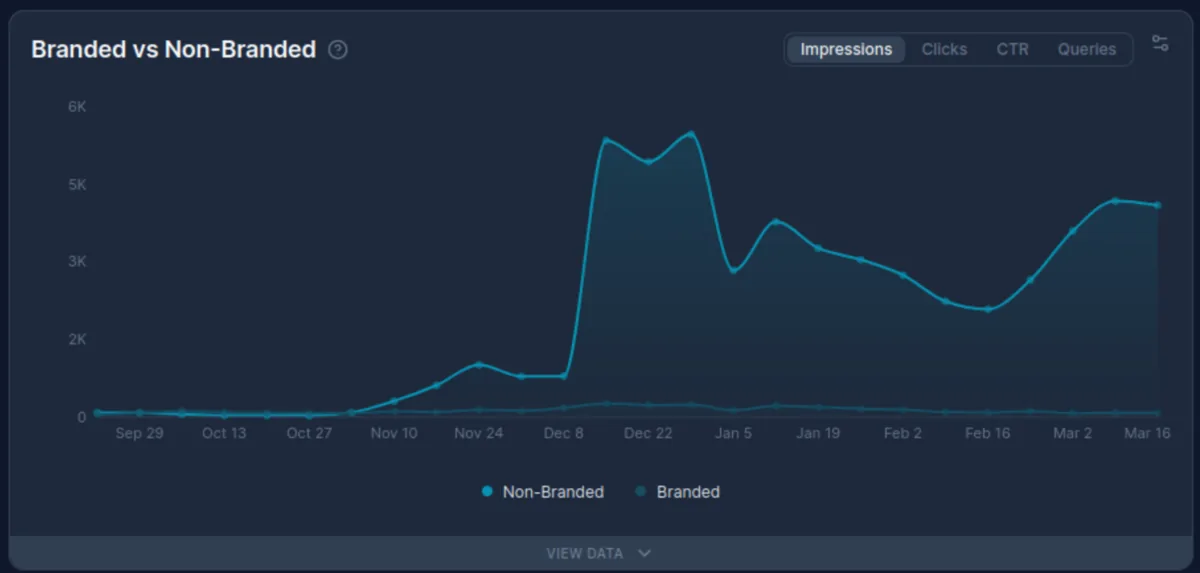
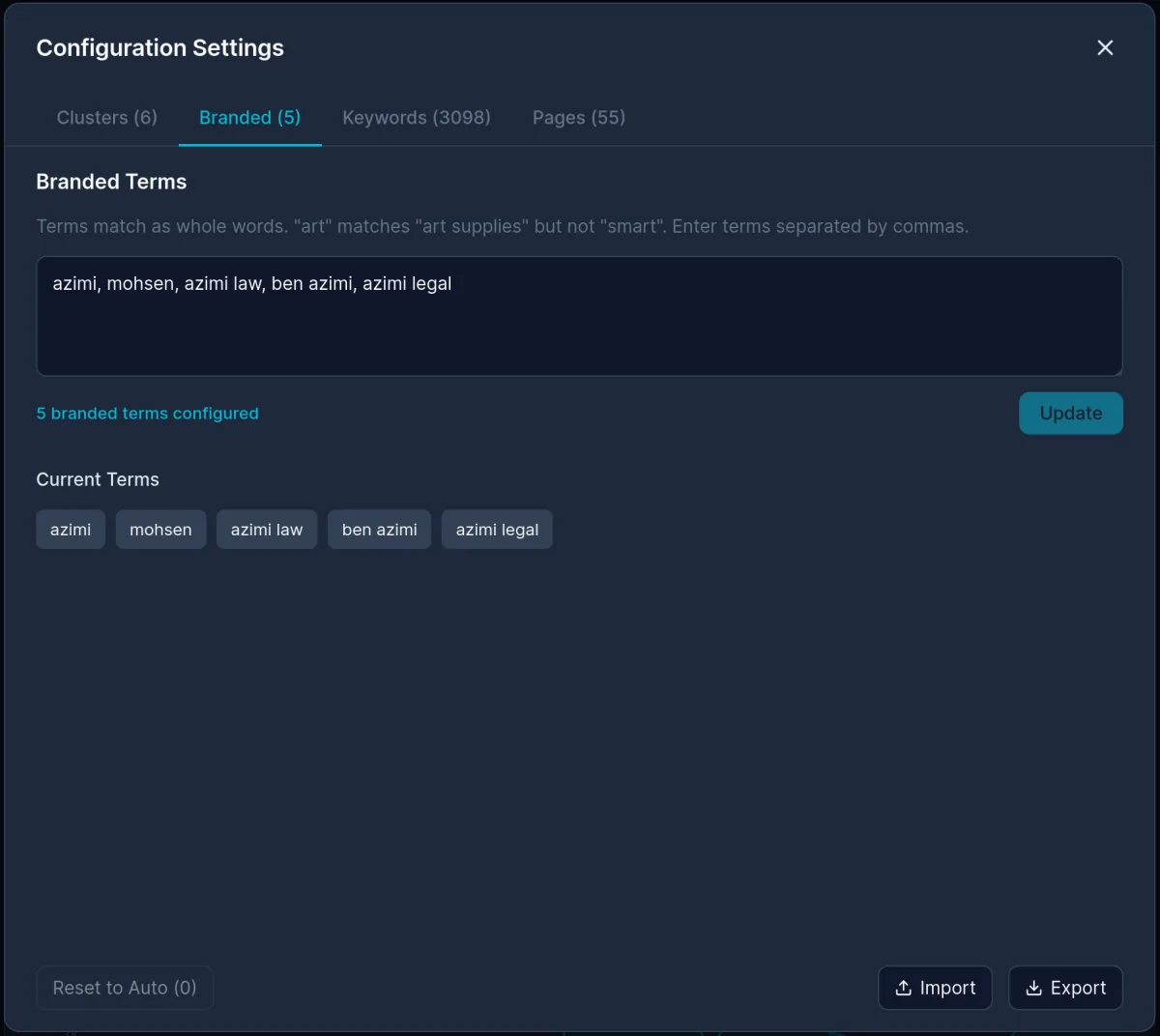
Non-branded impressions show a significant lead over branded impressions across the entire engagement - as the chart below demonstrates. The large surge line through December and the growing trend through March is entirely non-branded traffic from strangers finding this practice through organic search. Branded impressions remain relatively flat throughout. The meaningful signal is in the click data: despite that massive gap in impressions, branded queries generate 108 clicks at a 3.3% CTR from just 14 unique terms, while non-branded queries generate 114 clicks at 0.21% CTR from 3,084 unique terms.
Lead Generation and ROI
The real measure of any SEO engagement is leads in, cases booked, and revenue generated - everything else is a proxy. Over six months this practice generated 124+ total organic lead actions across three independently tracked channels:
- 47 cold email leads through the website contact form, tracked in the site's email system. 70% were LTB-related.
- 54 website call interactions recorded in GA4 from 43 unique users - people tapping the call button on the website.
- 23 direct calls from Google Business Profile, tracked separately through GBP Insights.
These are three separate tracking systems with no overlap between them. None are referrals. All represent people who discovered this practice through organic channels that did not exist before September 2025. The combined 124+ organic contact actions represent the all-channel direct organic lead figure for this engagement.
| Month | Total Leads | LTB % | Notary % | Small Claims % | Other % |
|---|---|---|---|---|---|
| September 2025 | 0 | - | - | - | - |
| October 2025 | 3 | 100% | 0% | 0% | 0% |
| November 2025 | 9 | 44% | 33% | 22% | 0% |
| December 2025 | 11 | 64% | 9% | 27% | 0% |
| January 2026 | 8 | 88% | 0% | 0% | 12% |
| February 2026 | 5 | 60% | 20% | 0% | 20% |
| March 2026 | 11 | 73% | 0% | 9% | 18% |
| 6-Month Total | 47 | 70% | 10% | 10% | 10% |
Atlas Arrow Digital
Ranking Growth
The ranking trajectory from 197 keywords at Month 3 to 3,094 at Month 6 is not linear growth - it is compounding authority, where each new page benefits from the topical trust built by every page that came before it.
| Position Range | Month 3 (Dec 2025) | Month 6 (Mar 2026) | Growth |
|---|---|---|---|
| Positions 1-3 | 10 | 1,247 | +12,370% |
| Positions 4-10 | 16 | 472 | +2,850% |
| Positions 11-20 | 34 | 349 | +927% |
| Positions 21-50 | 137 | 531 | +288% |
| Positions 51-100 | 0 | 495 | New |
| Total Ranking | 197 | 3,094 | +1,470% |
Atlas Arrow Digital
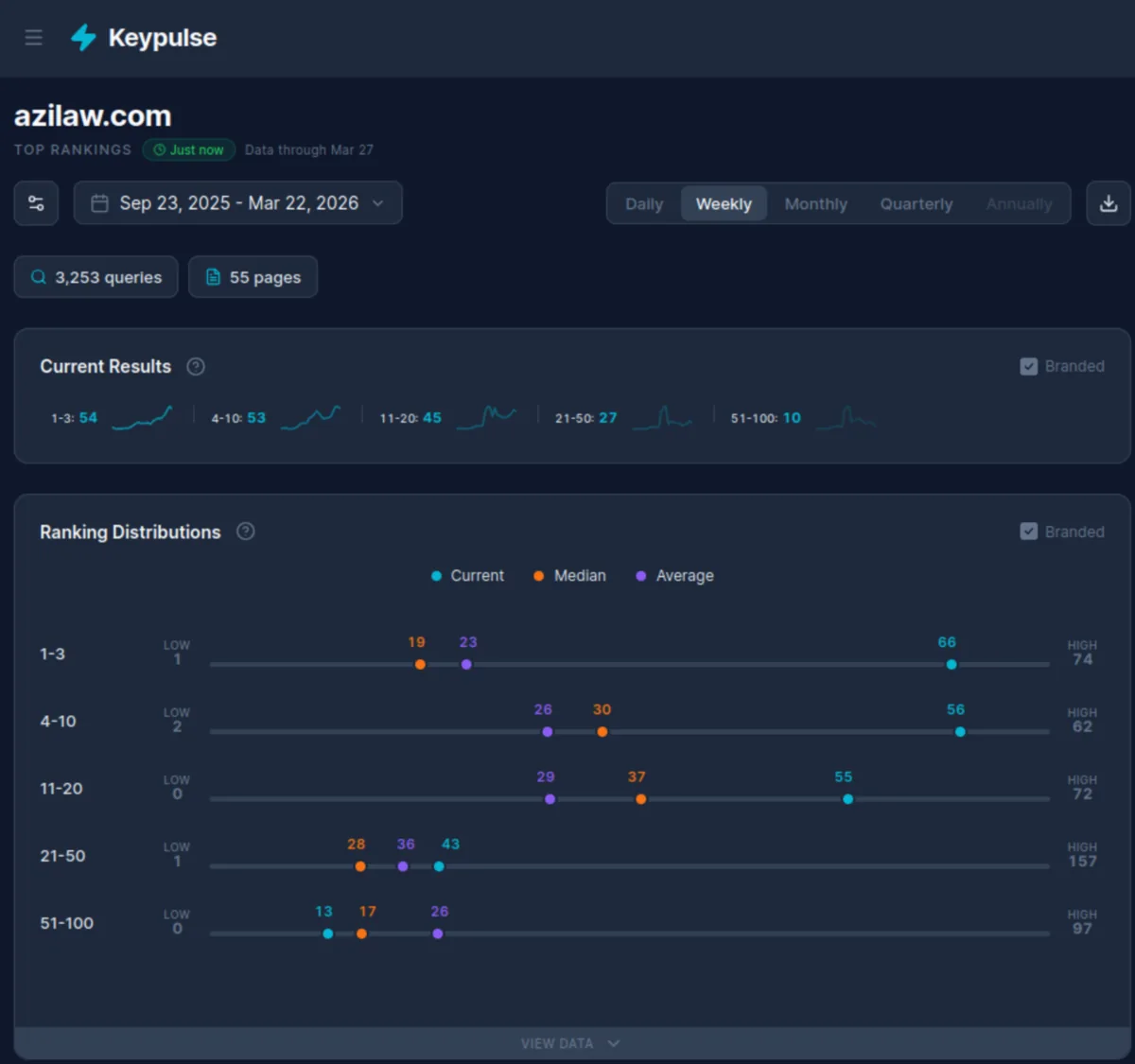
Source: Keypulse | Click to enlarge
The more meaningful story in the ranking data is how informational page growth has directly contributed to commercial page ranking improvement. As LTB form guides and process explanations accumulated authority and impressions, the LTB service page climbed from well outside the top 20 toward positions 10 to 15 for competitive paralegal queries. The same relationship is now developing between the Small Claims informational layer and the Small Claims service page. The informational content creates the topical footprint. The commercial pages inherit the authority. That is the architecture working as designed.
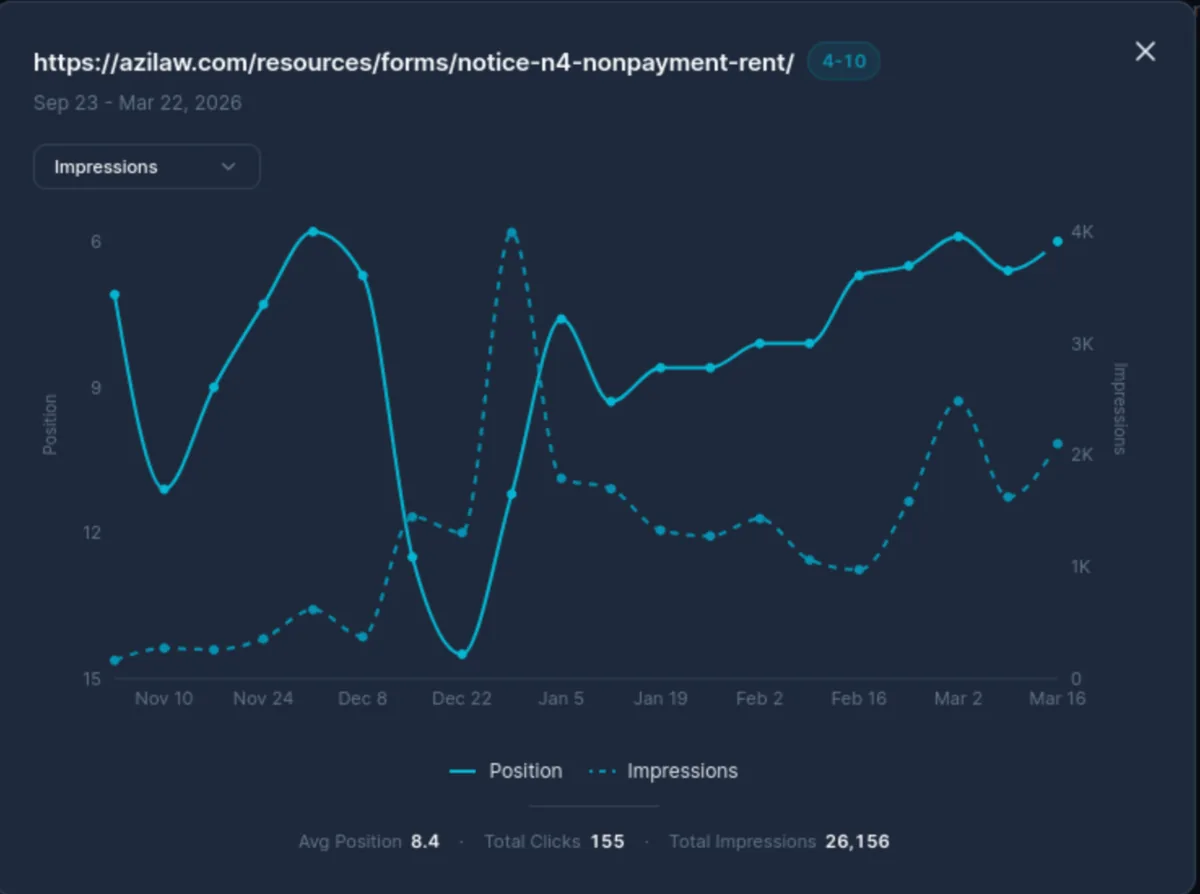
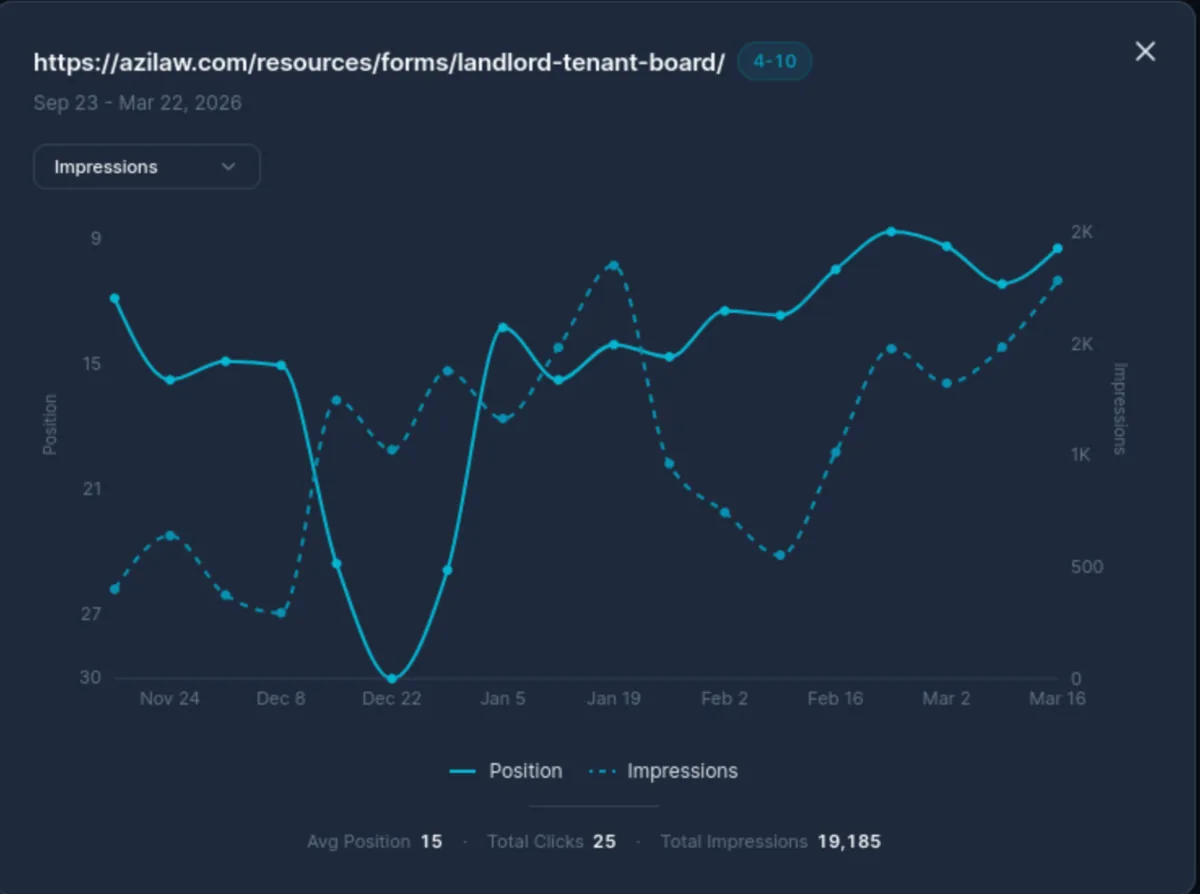
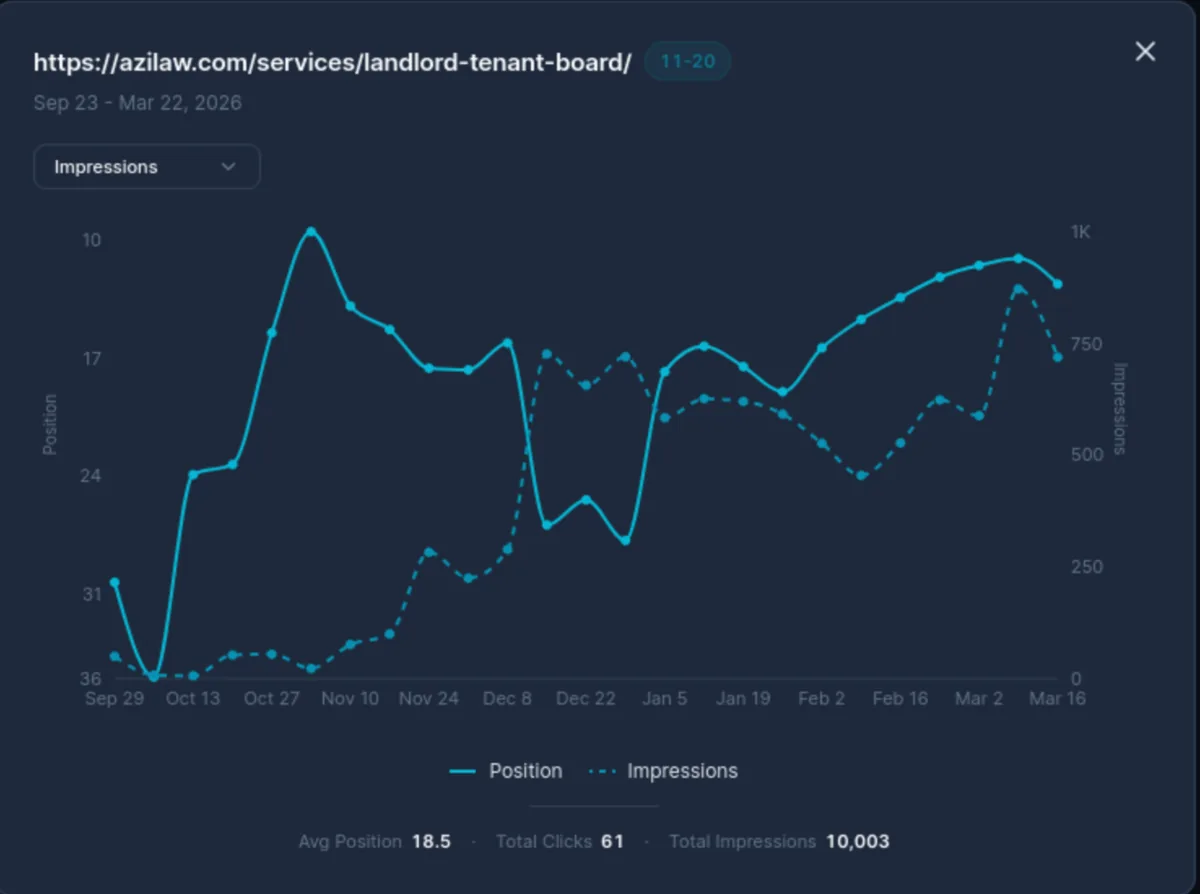
The N4 form page averaged position 8.4 across the full engagement with 26,156 total impressions. The LTB forms hub averaged position 15 with 19,185 impressions. The main LTB service page averaged position 18.5 with 10,003 impressions. The informational pages sit higher in the rankings today - that is the topical authority flowing downward into the commercial tier as the engagement continues.
The position and impressions trajectory for each of these pages tells the story directly - the informational pages leading, the commercial page following the authority upward.
Source: Keypulse | Click to enlarge
Source: Keypulse | Click to enlarge
Source: Keypulse | Click to enlarge
Key Takeaways
Organic search visibility for a legal practice is built through the same principles that have always governed how search engines work, applied with more precision and more patience than most competitors are willing to commit to. Technical foundation is the prerequisite for everything else - especially the technical architecture of the digital presence. Content sequencing matters because authority accumulates topically, and a site that demonstrates genuine expertise in a focused area outperforms a site with scattered coverage across too many areas at once. Informational content built to serve people in real legal situations functions as a lead funnel when properly connected to commercial pages through contextual internal linking - the 389 form downloads from 176 unique users in this engagement are direct evidence of that.
Zero backlink spend produced 1,247 top-three positions and a 6-12x ROI for a Toronto legal practice. In a niche like Ontario paralegal services, with the right technical foundation and topical architecture, content quality and semantic structure are sufficient to produce meaningful commercial results before any off-page work is required. The content is the authority signal. The architecture is the delivery mechanism.
The most important metric in an SEO engagement is the one that connects directly to revenue. Impressions measure visibility. Clicks measure interest. Leads measure intent. Cases booked measure value. Every reporting layer below revenue is a proxy, useful for diagnosing performance but not the point. In this engagement, the proxies are strong and the bottom line is stronger. 124+ organic leads across email, phone, and GBP - 47 cold email leads, 70% LTB - with case values between $1,000 and $2,000 per matter, generated by an organic digital presence built from zero in six months.
What Comes Next
Months seven through twelve build on established authority with a clearer and more aggressive mandate. The first priority is the family law vertical. Azimi Legal Services is broadening its service types to include Family Legal Services. Expanding into family law is a natural and deliberate evolution of the practice - it deepens the service offering, widens the client base, and follows the same compounding content strategy that has already produced results across LTB and Small Claims. The strategy will be similar - build the commercial pages and informational content architecture to help genuinely educate the marketplace, while building expertise and authority across search surfaces. Family law paralegal services in Ontario is a genuinely emerging search category with very limited topical competition from existing practices. As my SEO market research report across 69 Ontario law firms confirmed, no family law practice in that sample exceeded $10,000 in monthly organic traffic value - the category is wide open for a practice willing to invest in content depth.
The commercial and transactional pages get more direct investment in the next phase. With topical authority now firmly established across informational content, the ranking signals needed to push the LTB paralegal and landlord-tenant board service pages into the top five are within reach. The cluster is converting at 0.94% CTR from positions 10 to 25. That CTR typically doubles or triples in the top five. Competitive monitoring also becomes a standing priority as the practice grows - the stronger the positions get, the more competitors notice and the more actively they work to reclaim them. Staying on top is a different job than getting to the top, and the ongoing work reflects that.
AI search visibility will receive explicit, dedicated optimization work in the next six months. The site already appears in Google AI Overviews for multiple LTB and Notary queries - a direct result of the structured, entity-coherent content architecture built over the first six months. As AI-mediated search continues to grow as a discovery channel for legal services, the practices appearing in those answers have a compounding advantage over those that don't. The same content principles that produce traditional organic rankings - depth, structure, genuine expertise - are the same principles that produce AI citations. The work is aligned. The explicit focus is new.
FAQ
How long does it take for legal SEO to generate a positive ROI?
This case study achieved a 6-12x ROI within six months for a legal practice starting from zero organic visibility. The first leads appeared in Month 2, with consistent growth through Month 6 producing 47 cold email leads and 54 website call interactions. The timeline depends on the technical foundation being built correctly first - months one and two produced the infrastructure that made months three through six commercially productive. The same methodology applies to legal practices across Canada, the US, and other competitive legal markets.
Can a legal practice rank without buying backlinks?
Yes. This case study produced 3,094 ranking keywords, 1,247 top-three positions, and a 6-12x ROI with zero backlink spend. In competitive legal niches, content quality, topical architecture, and technical foundation are sufficient to produce meaningful commercial results before any off-page work is required. The approach works across legal markets in Canada, the US, and internationally.
What is a content cluster strategy for legal SEO?
A content cluster strategy groups content by practice area - such as LTB, Small Claims, and Notary - and builds depth within each cluster sequentially rather than spreading thin across all areas at once. Each cluster has informational content that builds topical authority and feeds ranking signals into commercial service pages through internal linking. The clusters are scaled up based on real lead data, not assumptions.
How many leads can legal SEO generate for a legal practice?
This legal practice generated 124+ total organic leads - 47 cold email leads, 54 website call interactions, and 23 Google Business Profile direct calls - over six months from organic channels that did not exist before the engagement. LTB representation accounted for 70% of email leads, with case values between $1,000 and $2,000 per matter before disbursements. These results reflect the methodology, not the geography - the same approach applies to legal practices across Canada, the US, and other markets.
What is the best order to build legal SEO content?
Technical foundation first, then commercial service pages, then informational content scaled by practice area. Starting with the lowest-competition cluster produces early ranking data and ROI evidence. Higher-value, higher-competition clusters are scaled up once the foundational authority is established. Publishing everything at once burns through your best material early and creates thin coverage.
Does legal SEO work for solo practitioners and small firms?
Yes. This case study was for a solo licensed paralegal practice. The same principles apply to small law firms and solo practitioners across Canada, the US, and other competitive legal markets: technical foundation, topical authority through informational content, and semantic architecture connecting informational pages to commercial service pages. The size of the practice does not limit the effectiveness of the strategy.
Ready to Build a Legal SEO Presence That Generates Cases?
Zero to 3,094 ranking keywords. 124+ organic leads across email, phone, and GBP. A 6-12x ROI in six months with zero backlink spend. If you run a legal practice in Toronto, Ontario, or anywhere in Canada and want organic search working as a client acquisition channel rather than an afterthought, let's talk.
Get Your Free Legal SEO Consultation